
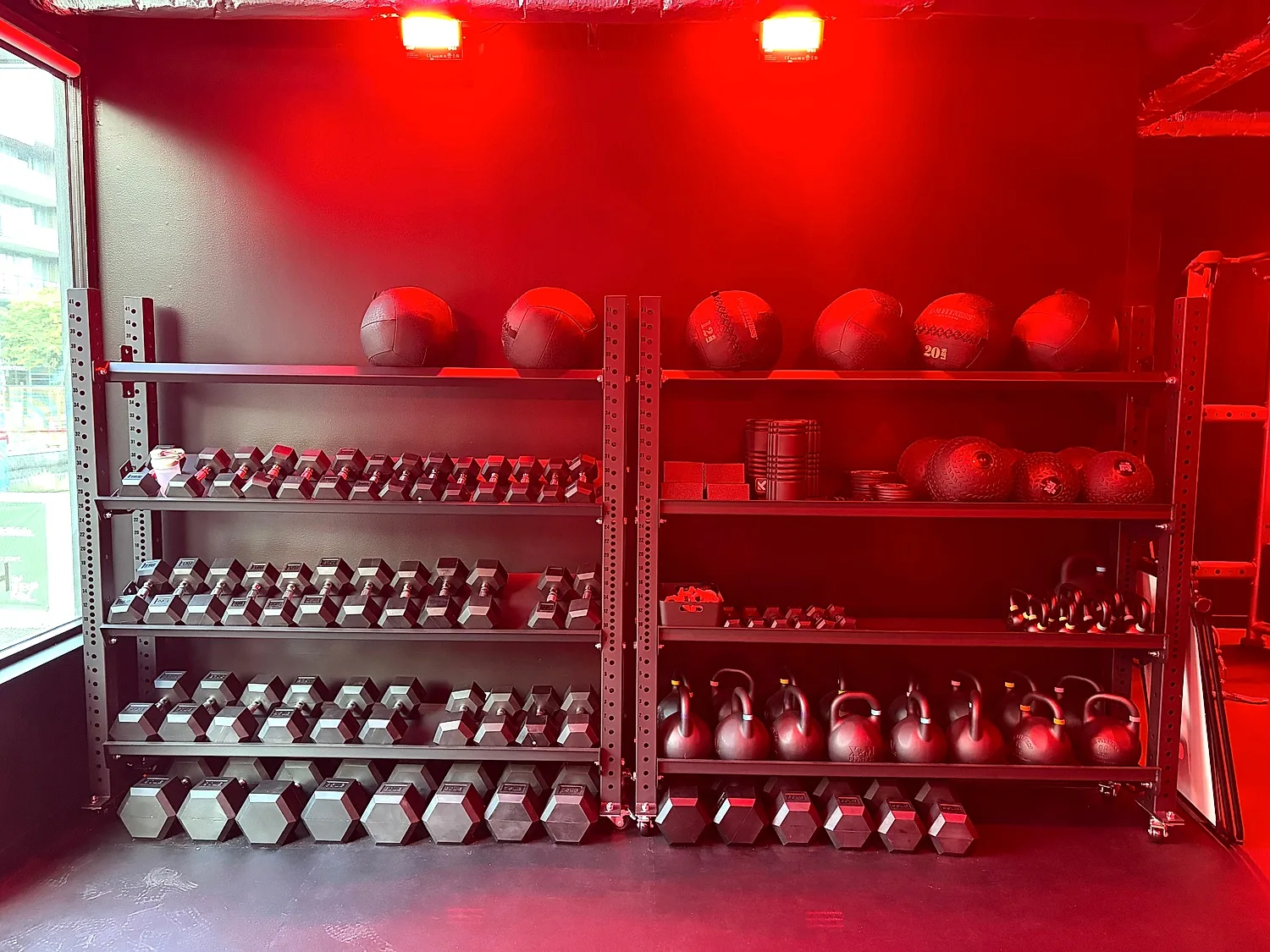
Semi-private personal training is one coach working with a few people at once, each person on their own program and their own loads. It is personal training with the hour shared: your session is still prepared before you arrive, your weights are still chosen for you, and your record still decides what happens next time. What changes is that the coach's attention is divided among a handful of people instead of resting on one, and the per-session cost comes down with it.
At Coresa it is one of the two ways we deliver personal training, alongside 1-on-1. We no longer run larger small group sessions. This page explains what semi-private means, what you give up and gain against a private hour, who tends to choose it, and how it starts here.
What semi-private means, anywhere
Semi-private is an industry label rather than a regulated one, and it usually describes three things at once: a very small group, one coach for all of them, and a separate program for each person. The third part is what separates it from a class. In a semi-private session the person beside you may be squatting while you press, because you are on different pages of different programs, and the coach moves between you rather than running the room.
The label gets stretched. Some studios call two friends on a shared workout semi-private; some call a room of ten the same thing. The questions that settle what you are buying are how many people the coach will take, whether your loads are chosen for you, and whether anyone writes down what you did. What is semi-private training covers the term itself; this page is about how it works in practice here.
The attention arithmetic: one coach, moment by moment
A coach's attention is finite, and where it lands changes with the number of people in front of them. The sets that need eyes are the heavy ones, the new ones, and the ones done by somebody tired enough to lose position. The table follows a single session through both formats. It is the general shape of each, not a promise about a particular session.
| Moment in the session | 1-on-1 | Semi-private |
|---|---|---|
| Warm-up | Every rep watched and adjusted | Started together, then the coach circulates |
| Your first working set | Coach is beside you before the weight moves | Coach reaches you during the set |
| Your heaviest set | Spotted and cued throughout | Usually watched, because few sets compete for it |
| A movement that needs swapping | Changed on the spot, plan rewritten | Written in advance from your record, adjusted live |
| The note afterward | Detailed | A line per lift |
Two things fall out of that table. First, both formats rely on the same machinery: a session prepared before you arrive, loads chosen for you, and a record that decides what happens next time. Second, the moments that matter most, the heavy set and the swap, are handled in advance in a semi-private session, which is why it is still honest personal training rather than a class with a smaller cap.
Who chooses semi-private
Four kinds of people ask us for it, and they ask for different reasons.
- Partners with different goals. One wants a heavier deadlift, the other wants to get through ski season without sore knees. A shared session with separate programs lets them train at the same hour without pretending they want the same thing.
- People coming out of physiotherapy. Discharged, cleared to load, and rightly cautious. They want more eyes on the first weeks of real weight than a class offers, without paying for undivided attention they will not need for long.
- Experienced lifters who want programming, not exclusivity. They know how to squat. What they lack is somebody to write the block, choose the loads and notice when the bar slows. They do not need a coach beside every set.
- People who want personal coaching on a tighter budget. Semi-private costs less per session than 1-on-1 and delivers most of the attention. For a general strength goal, that is a good trade.
If you recognize yourself in one of those, say so on the consult. It changes where we suggest you start.
What you give up versus 1-on-1, and what you gain
You give up three things. The session runs at a set time rather than around your calendar. The coach's attention is shared, so a fault in your form may be corrected on the second rep rather than the first. And a technique rebuild that needs a coach on every rep for a month, which is common after a long layoff or an injury, is slower here than in 1-on-1 personal training.
You gain three things back. There is somebody beside you, which most people find makes hard sets easier to finish and missed sessions harder to justify. Your program is still yours: the Romanian deadlift on your card is loaded for you, not for the room, and the cues are the ones you would hear alone. And the per-session cost is lower, which for most people means more sessions a week, and frequency is where results come from.
The honest summary: choose 1-on-1 when what you need is a coach's full attention for a defined stretch. Choose semi-private when what you need is a program, a record and company. Plenty of members do both: a private session to set the block, semi-private sessions to carry the volume.
How it starts here
- The consult. A fifteen-minute phone call, no workout and no card. A coach asks what you are training for, what your body objects to, and which hours you can defend, then tells you honestly whether 1-on-1 or semi-private fits. Book it on the booking page or call (236) 868-9964.
- Assessment. Your first session sets starting loads with control and reps in reserve; nobody tests a maximum on day one. Your coach writes your program from what they see.
- The first block. The same lifts return, the loads move when your sets say they should, and the record keeps the thread between sessions, whoever else is in the room.
Sessions are booked individually in the Coresa app, so a placement is a starting point, not a contract. How packages are structured is explained on the consult.
Where we are
Coresa is at 142B 3rd Street West in Lower Lonsdale, a few doors west of Lonsdale Avenue and roughly a six to eight minute walk uphill from the Lonsdale Quay SeaBus terminal. Doors are open 6:00 am to 8:00 pm seven days a week, and parking is on the street, so the early sessions are the easy ones to drive to.
Common questions
Can I book a semi-private session at Coresa?
Yes. Semi-private is one of the two ways we deliver personal training, alongside 1-on-1. Start with the free consult so a coach can place you in sessions that match your goal and your hours.
Do we all do the same workout in a semi-private session?
No. Each person is on their own program with their own loads, prepared before the session. Two people in the same room may share a warm-up and a rack and still be doing different lifts for different reasons.
Can two people with different goals share a session?
Yes, and it is one of the most common reasons people choose semi-private. A runner building leg strength and a partner rebuilding after a shoulder injury can train side by side because the program is individual and the coach moves between them. Training with a friend covers how to set it up.
Who is semi-private wrong for?
Anyone with pain that has not been assessed, who should see a physiotherapist first. Anyone whose technique needs rebuilding from scratch, who will get there faster with a 1-on-1 block. And anyone whose week cannot hold a fixed session time, because semi-private runs on the schedule and 1-on-1 runs around yours.